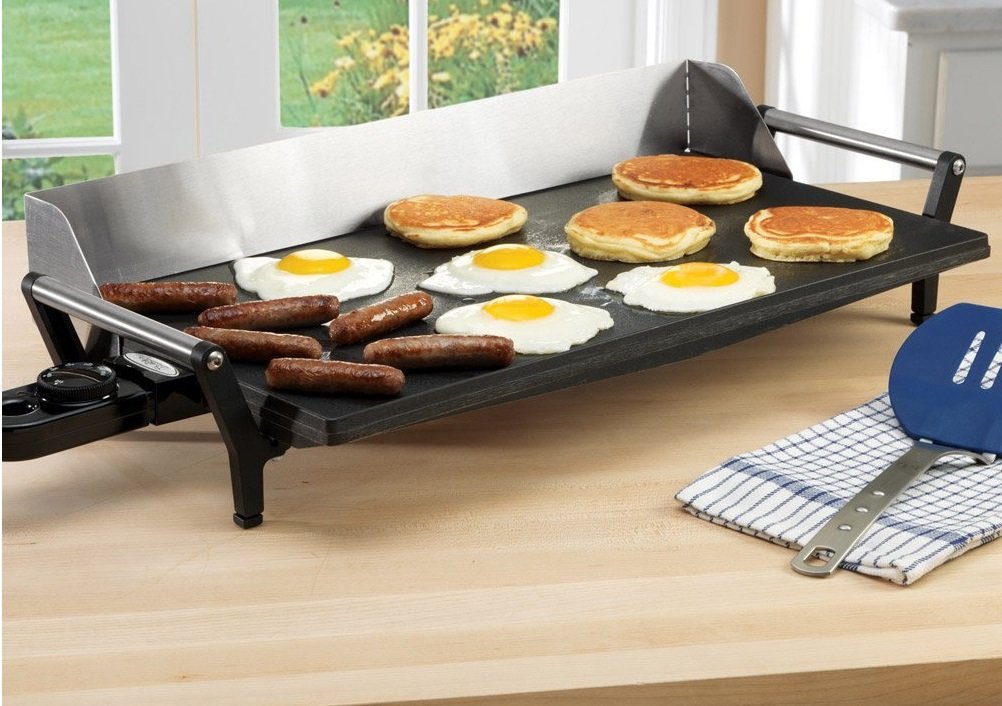
An electric griddle is worth owning when it solves a specific stovetop problem: it gives you more flat cooking area, lets you cook at the table, or keeps breakfast from happening in batches. The right one is not automatically the biggest. A large surface is useful for pancakes and burgers; it is a burden if it will not fit in a cabinet or sink. For most people who genuinely need countertop capacity, the Zojirushi Gourmet Sizzler EA-DCC10 is the top pick. Its 19-by-12.5-inch cooking plate, 176°F to 425°F control range, low-profile body guard, and fully immersible parts make it a serious family-size appliance rather than a flimsy breakfast novelty.
The Zojirushi Gourmet Sizzler EA-BDC10 is the pick for a smaller household that wants a table-ready griddle with a lid. Its 14.125-by-13.125-inch surface and 176°F to 400°F range take less space, while the lid helps with splatter and steaming. The Hamilton Beach 3-in-One Grill/Griddle suits the buyer who values removable plates and wants both a flat griddle and a grill configuration. Its compromise is obvious: a reversible or divided appliance adds parts and is less single-minded than a dedicated large plate.
Quick picks
| Pick | Best for | Main trade-off |
|---|---|---|
| Zojirushi EA-DCC10 | Family breakfasts and large batches on one continuous plate | Large footprint and higher price |
| Zojirushi EA-BDC10 | Smaller homes and at-the-table cooking with a lid | Less cooking area and a lower maximum temperature |
| Hamilton Beach 3-in-One | People who will use grill and griddle plates interchangeably | More pieces and less focused flat-griddle performance |
The Zojirushi EA-DCC10 is the large electric griddle to buy
The Zojirushi Gourmet Sizzler EA-DCC10 is for the cook who actually needs a large, controlled flat surface. Zojirushi specifies a 19-by-12.5-inch cooking area, an overall body measuring roughly 23.6 by 15 inches, 1,350 watts of power, and variable heat from Keep Warm at 176°F to 425°F. That is enough room to cook a full pancake batch, several burgers, or a large pile of vegetables without constantly moving food to a holding plate.
Surface area is the first reason to choose it. A large griddle gives food room to cook instead of crowding together. Pancakes stay round and easy to flip. Bacon has space to render rather than overlap. Burgers can brown without releasing a pool of steam around every patty. The larger plate does not make any food better by itself; it simply lets you cook more portions under similar conditions at the same time.
The second reason is cleanability. Zojirushi says the body guard and cooking plate are fully immersible after the temperature control plug is removed. That matters because a big griddle is only convenient if cleanup is not a negotiated project. The plate uses a titanium- and ceramic-enhanced triple-layer nonstick coating, and the low-profile plate sits inside a body guard. The guard is designed to protect against scalding, not to eliminate the need for ordinary care around hot grease.
The EA-DCC10 has a wide heat range, but numbers on a knob are not a promise that every corner is the same temperature. Preheat it thoroughly, let it recover between cold batches, and avoid loading the whole plate with refrigerator-cold food at once. The higher temperature setting is useful for browning; medium heat is usually more appropriate for eggs and pancakes. A griddle rewards simple staging: cook potatoes or bacon first, wipe excess grease safely, then lower the heat for eggs.
The compromise is size. This is a 12-pound appliance with a plate wider than many sinks. Measure the cabinet, shelf, and counter before buying. A large griddle is a good purchase only if it can be stored without dread. It also uses a removable temperature-control plug; do not submerge the plug, and do not clean the appliance until it is cool and unplugged. Check current EA-DCC10 availability on Amazon.
Choose the EA-BDC10 for a smaller table setup
The Zojirushi EA-BDC10 is a more focused choice for a couple, a small family, or a table-cooking routine. Its cooking surface is 14.125 by 13.125 inches, while the body is roughly 19.4 by 15.4 inches. It runs at 1,300 watts and offers a Keep Warm setting at 176°F through 400°F. That surface is still large enough for a modest breakfast, but it does not demand the same storage commitment as the EA-DCC10.
The lid is the useful difference. It can speed some cooking, hold gentle heat, and limit oil splatter. It is not a pressure cooker and it will not give you the dry high-heat environment of an oven. Treat it as a practical cover for vegetables, burgers, or a breakfast hash where a short covered period helps the center cook through. Keep an eye on condensation; a lid can soften a crisp surface if it stays on too long.
Zojirushi also lists fully immersible body guard and cooking plate components, a triple-layer nonstick coating, and a design that will not heat unless it is installed correctly. Those are strong ownership features. The plate and drip-tray assembly must still be put together correctly, and the appliance should be used on a stable, heat-resistant surface with space around it. Electrical safety features support good practice; they do not replace it.
Choose the smaller Gourmet Sizzler if you want to cook at the table, have a limited counter, or frequently cook a meal for two to four people. Skip it if you need to feed a crowd in one batch. Its capacity is substantial for its footprint, yet there is no substitute for the wider EA-DCC10 when you need a long row of pancakes or several burgers plus vegetables at once.
The Hamilton Beach 3-in-One is for two kinds of cooking
Hamilton Beach’s 3-in-One Grill/Griddle earns a place for a buyer who will use a flat griddle one day and a grill surface another. Its removable PFOA-free plates are designed to make the appliance more adaptable than a dedicated one-piece griddle. That can be an excellent use of a small kitchen, particularly if the alternative is owning two countertop appliances.
The trade-off is that convertible gear asks more from the cook. Plates need to be installed, cleaned, dried, and stored. A divided setup may not give you the uninterrupted surface needed for a large pancake round. Grill grooves are useful for some foods but not helpful for eggs or delicate pancakes. Do not buy a hybrid just because it has a longer feature list. Buy it because you will make grilled sandwiches, vegetables, or indoor grilled meals often enough to use the second configuration.
A dedicated flat griddle is simpler for breakfast and batch cooking. A convertible model makes more sense for a renter, small kitchen, or occasional cook who values range over one optimized job. The best choice is the appliance with the surface you will use most, not the appliance with the most possible settings.
Size and storage decide more than brand
Measure a griddle in working space, not just plate size. You need a heat-safe place for the appliance, access to an outlet without stretching the cord, space for a plate of raw food and a plate of cooked food, and a clear place to set the hot lid or spatula. Then measure where it will live. A griddle that must be stored behind heavy cookware will be used less often than a slightly smaller model that fits on a shelf.
For two people, a 14-inch class plate can be enough for pancakes, eggs, vegetables, or a few sandwiches. For a family breakfast or weekly burger night, the 19-inch class plate is more practical. Do not assume a large plate is always better. A half-empty large griddle still uses counter space and takes longer to clean, while a small one can encourage fresh batches instead of food sitting around.
Think about the lip and grease system as well. A shallow plate is easy to access with a spatula. A body guard can contain splatter and help guide grease toward a tray. None of these features make hot fat harmless. Keep handles turned away from edges, use a splatter guard only if it does not trap heat where it is not wanted, and empty the drip tray after the griddle cools enough to handle safely.
Temperature control: use the right heat for the food
Preheat before adding food. The dial setting does not instantly become the plate temperature, and food added too early sticks more readily and cooks unevenly. For pancakes and eggs, start at a medium setting and test one small piece of food. For burgers, sausages, and vegetables, use a higher setting only after the surface has preheated. A setting near the appliance’s maximum is not automatically better; it can overbrown the outside before the center catches up.
Make batches predictable. Start with ingredients that tolerate holding well, such as bacon or potatoes. Move them to a warm plate or low oven, then cook faster items. Wipe excess grease with a heat-safe utensil and paper towel held in tongs only after disconnecting power or when the plate has cooled enough; do not drape paper near an active element. Add oil sparingly. Nonstick surfaces usually need less than a cast-iron griddle, and too much oil can make pancakes fry instead of brown evenly.
Use a food thermometer for burgers, chicken, and other proteins that require a safe internal temperature. A griddle’s dial measures the plate control, not the food’s center. This is especially important when a lid is on: a covered surface can cook the top, but only a thermometer tells you whether the thickest part has reached the appropriate temperature.
Nonstick care is part of the purchase
Use wood, silicone, or other utensils the manufacturer permits. Avoid metal tools unless the manual explicitly allows them. Do not cut food on the plate. A nonstick coating can last a long time with ordinary care, but it is not immune to scraping, overheated empty cooking, or abrasive pads.
Let the plate cool, remove the temperature-control plug, and clean according to the manual. A fully immersible plate or body guard means the relevant removable parts can be washed; it never means the plug or electrical connection can be submerged. Wipe food residue before it bakes on, wash with a nonabrasive sponge, and dry components before reassembly. Do not store a heavy object on top of the plate if it can scratch the surface.
Replace a griddle when the coating is deeply damaged, the temperature control behaves unpredictably, or the cord and plug show wear. Do not keep using an appliance that heats intermittently or has a damaged electrical part. Repair options and replacement parts may be available for some models, but electrical safety is not a place to improvise.
What not to buy
Skip a tiny breakfast griddle if you are really trying to replace a stovetop pan for a family. It will be cheaper, but slow batches will erase the convenience. Skip an enormous professional-style model if you only cook two eggs on weekends. It will occupy a cabinet and make cleanup disproportionate to the meal.
Skip appliances that promise interchangeable uses you will not use. A grill plate is a benefit for someone who cooks grilled food; it is clutter for someone who only wants pancakes. Likewise, do not buy a high-price model solely for a nonstick coating description. Surface size, heat control, cleanup, and safe storage have more effect on everyday satisfaction.
If you need an outdoor high-heat griddle for a patio or campsite, that is a different category. Countertop electric griddles are designed for indoor power and controlled indoor use. Do not run an indoor appliance outside in weather or in a location where the cord and plug are exposed to moisture.
When a skillet or crepe pan is the better tool
An electric griddle cannot replace every flat pan. A skillet is better for sauces, pan-searing a small portion, and moving food from stovetop to oven when the pan is oven-safe. It also takes less storage and warms quickly for a single egg or grilled sandwich. A crepe pan has lower sides and a smaller, more maneuverable surface for thin batter. If crepes are the main reason you are shopping, our crepe maker and pan guide will point you toward the more appropriate format.
Choose a countertop griddle when quantity and continuous space are the actual goals. It earns its place for a weekend breakfast where one cook needs room for bacon, pancakes, and eggs, or for a table meal where people cook vegetables and proteins as they eat. It is less useful for a regular dinner that fits comfortably in two skillets. The largest appliance is not always the most capable setup; the best tools can work together.
A realistic batch-cooking workflow
Plan a griddle meal in temperature zones over time, not necessarily on the plate at once. Preheat, cook the item that needs the most space, and move it to a warm holding dish. Bacon or sausage can come first. Pancakes can follow on a cleaner, lower-temperature surface. Eggs should come last, after the plate has been wiped and the heat has been lowered. This sequence preserves room and avoids asking one fixed-temperature surface to do three contradictory jobs.
For burgers, preheat fully and leave room between patties. Add vegetables after the first side is seared, using the cooler edge if needed. Do not flatten burgers with a spatula to hurry them; that sends juice onto the plate and makes the surface steamier. For food-safety and equipment decisions beyond the griddle itself, our kitchen basics guide can help organize a more complete cooking setup.
How we researched
We compared current manufacturer specifications for surface size, total dimensions, wattage, temperature range, cleaning design, coatings, safety features, removable parts, and use cases. We chose products that serve genuinely different kitchens and did not claim hands-on testing. Cooking results still depend on preheating, batch size, food temperature, and technique, so the guide focuses on matching the appliance to the job.
Electric griddle questions, answered
Are electric griddles worth it?
They are worth it when you regularly need a larger flat surface, table cooking, or more capacity than one skillet provides. For occasional eggs, a skillet is simpler.
What size electric griddle do I need?
A 14-inch-class surface suits small households. A 19-inch-class surface is more useful for family breakfasts and batch cooking. Measure storage before deciding.
Can I wash an electric griddle?
Only wash the removable parts the manufacturer says are washable, after the appliance is cool and the control plug is removed. Never immerse the electrical plug.
How do I keep food from sticking?
Preheat, use a modest amount of appropriate fat, avoid overcrowding, and use nonmetal utensils. Clean residue before the next cooking session.
Affiliate note: SuperGrail may earn a commission when you buy through an Amazon link. That does not affect the recommendations or trade-offs in this guide.