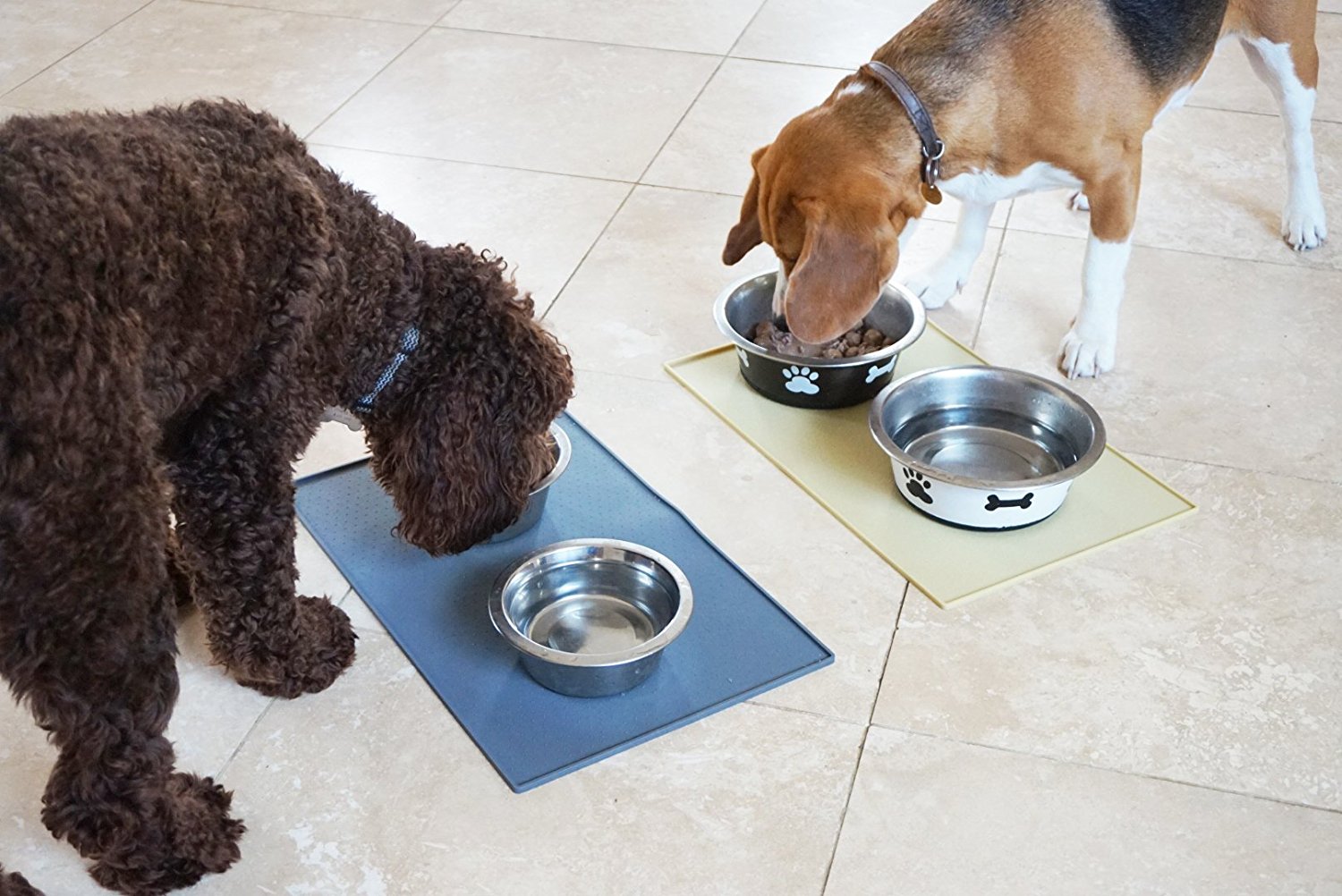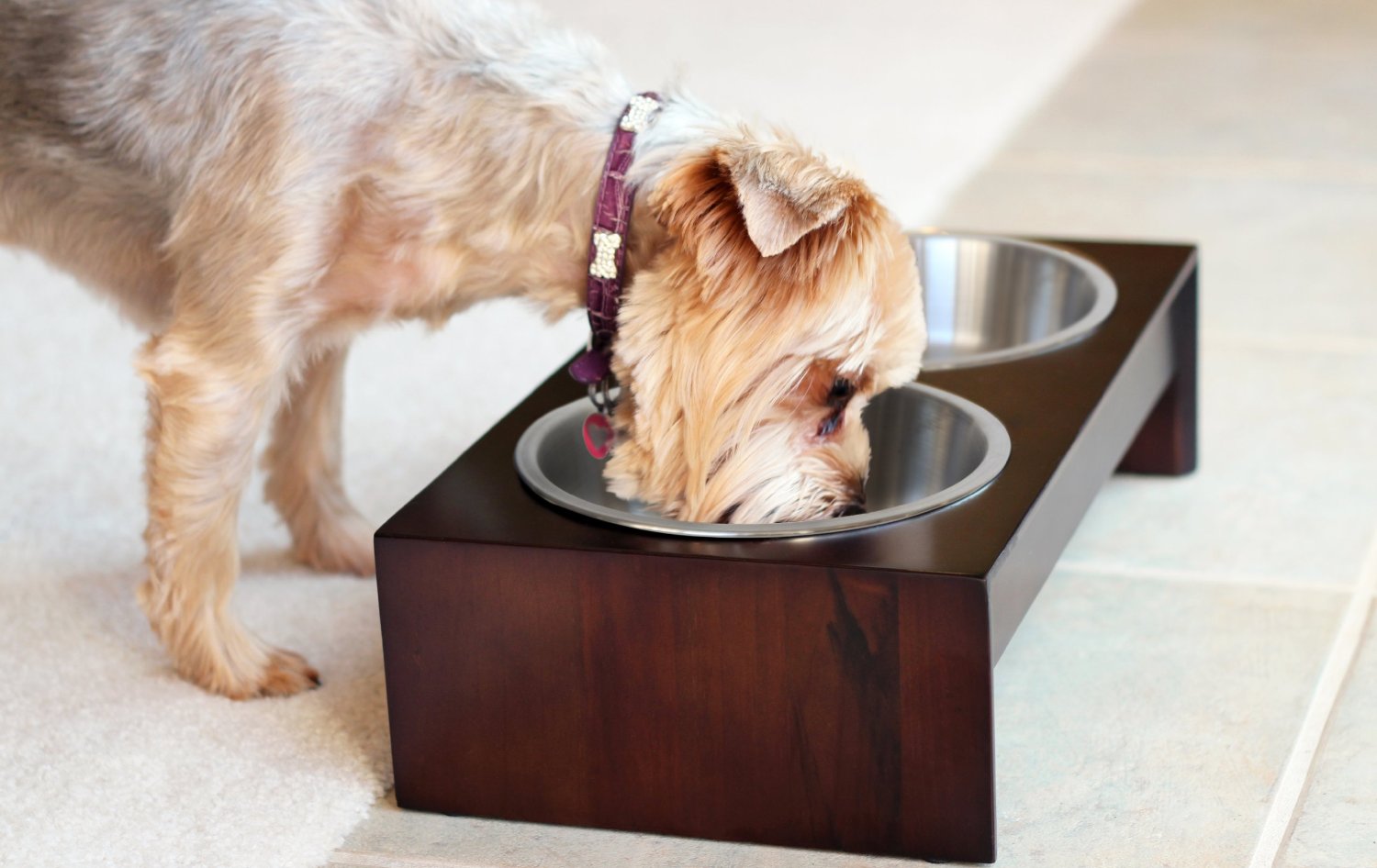
A raised bowl is not automatically better than a bowl on the floor. Most healthy dogs do well with a regular bowl, and a stand changes their eating position in ways that should have a specific reason behind them. If a veterinarian has suggested a particular height, begin there. If the goal is simply to create a stable, defined feeding area, a low stand is the sensible first step. Our pick for that job is the Basis Pet Rise stand in Low Rise: it holds the company's large stainless bowls, assembles without tools, has non-skid pads, and keeps the bowl only about four inches above the floor.
For a dog that splashes water or scatters food, choose the Neater Feeder Express instead. It is an elevated, contained feeding station with a top area for spilled food, a lower water basin, splash guards, and removable stainless bowls. The cost is more plastic and more parts to wash. The WeatherTech Single Low Pet Feeding System is the cleanest all-in-one option for one bowl: its bowl, stand, and mat are dishwasher safe, and it comes in different bowl sizes. A taller option should be a deliberate decision. The Basis Pet Rise High Rise puts the bowl at 11.5 inches and is useful only when that height is appropriate for the individual animal.
The right way to buy a raised feeder is to measure the available floor space, choose the bowl volume before the stand, and then choose the lowest height that solves the actual problem. Avoid vague promises about digestion or joint health. A stand can keep bowls organized and can be easier for a particular dog to reach; it cannot diagnose, prevent, or treat a medical condition.
Quick picks
- Best low stand: Basis Pet Rise stand, Low Rise. A 4-inch single or 4.5-inch double stand made from food-contact-safe HDPE, with non-skid pads; bowls are sold separately. Check the Basis Pet Rise Low Rise stand on Amazon.
- Best for splash containment: Neater Feeder Express. A low raised station with stainless bowls, splash guards, a food-catching top, and a lower water basin. Check the Neater Feeder Express on Amazon.
- Best single-bowl system: WeatherTech Single Low Pet Feeding System. A low stand, bowl, and mat designed as one dishwasher-safe setup. Check the WeatherTech Single Low system on Amazon.
- For a vet-recommended higher setup: Basis Pet Rise High Rise. An 11.5-inch stand for the same large bowls; choose it only with a concrete height requirement. Check the Basis Pet Rise High Rise stand on Amazon.
Our pick for a low, stable station: Basis Pet Rise Low Rise
The Basis Pet Rise Low Rise is a good raised bowl stand because it does not try to solve every dog problem with height. The single-bowl model is 10.5 inches square and four inches high; the double-bowl model is 19.5 by 10.5 inches and 4.5 inches high. The platform is made in the United States from food-contact-safe HDPE plastic, has non-skid pads, resists water and stains, and needs no tools for assembly. It is designed to accept Basis Pet's large stainless bowls, which are sold separately.
The low height is the main virtue. It gives a bowl a stable home, keeps it off a wet floor, and makes it less likely to skitter when a dog eats with enthusiasm, without forcing an aggressive change in posture. It is a practical option for a person who wants a feeding area that is easier to sweep around, a small amount of elevation for a known comfort preference, or a tidy double-bowl setup that can be lifted and cleaned.
Compatibility deserves attention. Buy the stand and correctly sized bowls as a system. A random dish that seems close in diameter can rattle, sit too high, or fall through an opening. Basis sells the stand for its large bowls, so it is not the flexible universal rack to choose if you already own a collection of different bowl shapes. The company also specifically advises its low stand unless a veterinarian recommends an elevated setup, which is sensible guidance rather than a sales pitch for more height.
Choose the Low Rise for a defined, stable feeding station and a dog who does not need special height accommodation. Skip it if the main problem is water spray around the entire feeding area; the Neater Feeder does more to contain that mess. See the Basis Pet Rise Low Rise stand on Amazon.
For the dog that turns water into a floor-cleaning job: Neater Feeder Express
The Neater Feeder Express earns its place because its design addresses a different problem: containment. Instead of resting two bowls in an open stand, the Express uses raised walls at the back and sides, a top surface that catches escaped food, drainage holes, and a lower basin for spilled water. The stainless bowls sit inside the station, while rubber feet help keep the unit from sliding. Both the feeder and bowls are dishwasher safe, with the feeder intended for the top rack.
The product comes in configurations that matter. The small dog version uses 1.5-cup bowls, is 12.9 by 8.75 inches, and puts the bowl rim about 2.75 inches high. The medium-to-large version uses seven-cup bowls, measures 19.5 by 12.7 inches, and puts the rim around 5.5 inches high, with taller splash guards. Choose by the bowl capacity, station footprint, and amount of spill control you need—not a marketing claim about breed or a desire to make the bowls look taller.
There is a cleaning cost to all that containment. Water that drains into a lower basin must be emptied frequently. Food caught on top must be removed before it becomes stale. The station has more crevices than a simple stand, and a dishwasher-safe label cannot clean itself. For a dog that only drops a few kibbles, a basic stand plus a silicone mat is simpler. For a dog that splashes the wall or regularly sends water across a floor, the Neater Feeder's extra parts have a clear job.
See the Neater Feeder Express on Amazon.
For a low one-bowl system: WeatherTech Single Low Pet Feeding System
WeatherTech's Single Low Pet Feeding System is the pick for a household that needs one food or water bowl in a contained low station, rather than a double feeder. The system includes the bowl, stand, and mat. It is offered with either a 304 stainless-steel bowl or a BPA-free plastic bowl, and WeatherTech says the complete system is dishwasher safe. The mat has a raised-rib position for the stand and a flat edge intended to sit against a wall to limit shifting.
The useful part is the modular simplicity. A single-bowl system works well for a dedicated water station in another room, a cat who should not share a dog feeder, or a household that wants to separate food and water. Because the bowl, stand, and mat were designed together, you do not have to calculate whether a chosen bowl will fit into a third-party cutout. The company offers different bowl sizes, so choose capacity based on the animal and refill routine.
It is less attractive if you need two bowls side by side or already own excellent stainless bowls. You pay for a complete system and cannot mix components as freely as you can with a simple stand. The visual footprint is also larger than a bowl alone. Buy it for its clean, single-station logic, not because a branded system somehow makes feeding more sophisticated.
See the WeatherTech Single Low Pet Feeding System on Amazon.
When a taller stand is genuinely appropriate: Basis Pet Rise High Rise
The Basis Pet Rise High Rise uses the same basic design as the low model, then raises the bowl to 11.5 inches. It is available in single and double configurations, made from the same water- and stain-resistant HDPE, with non-skid pads and tool-free assembly. The height makes it a niche recommendation, not an everyday upgrade.
Use a tall raised stand only when you have a specific, individualized reason to do so. That can be a veterinarian's recommendation, a feeding setup chosen as part of a care plan, or a measured comfort need that has been evaluated. Do not choose it based on a fear-based claim that all large dogs require raised bowls. Dogs vary in size, proportions, eating style, and health history. A stand that looks right beside a tall dog can still put the bowl at an unhelpful height.
When a higher stand has been recommended, measure from the floor to the intended bowl rim and compare it with the product's listed height. Leave space for the bowl itself. Confirm that the stand will not slide, rock, or interfere with a dog stepping up to eat. A tall empty stand is also easier to knock into than a low one, so put it away from high-traffic doorways and pair it with a mat if drips are part of the picture.
See the Basis Pet Rise High Rise stand on Amazon.
Height is the decision that matters most
Start by asking why the bowls need to move off the floor. If the answer is “they slide,” choose a non-slip bowl or low stand. If the answer is “water goes everywhere,” choose a contained station or add a large silicone mat. If the answer involves pain, swallowing, repeated regurgitation, a sudden change in appetite, or a diagnosed condition, talk with a veterinarian before changing the setup.
Do not measure a stand by the top of its frame alone. The bowl rim can sit higher or lower depending on the cutout and bowl depth. A dog should be able to approach the station normally; the stand should not force it to crowd into a corner or reach across a high rim. Small changes are easier to evaluate than jumping straight from floor level to a tall furniture-like feeder.
A low stand is also a good way to learn whether a raised station helps your household's routine. It adds organization without making a big positional change. If it does not solve the problem, you can identify what actually matters: less sliding, more water containment, a different bowl shape, or a feeding location with more room.
Measure the bowls and the room before ordering
Start with the bowl itself. For food, measure the portion you normally serve and choose a bowl that has room for it without filling to the rim. For water, choose a capacity that fits your refill routine, then refresh it rather than assuming a giant bowl can sit unchanged all day. A seven-cup bowl may be sensible for a large dog's water station and wildly oversized for a small dog’s meal. Capacity describes the container, not the amount to feed.
Next, map the stand's actual footprint with painter's tape on the floor. Include the room needed to lift a water bowl straight up, open an automatic feeder, or wipe behind the station. A double stand placed too close to a wall becomes tedious to clean. A large dog may also need clear space in front of the bowls so it is not repeatedly stepping on the mat edge or bumping furniture.
Stability matters as much as height. Push gently on an empty stand after it is assembled. It should sit flat without rocking. Put it on a level surface, not over an uneven grout line or a curled rug. If the dog noses bowls around, use a stand with non-skid feet and a mat with a grippy base; do not try to solve movement by adding height. More height can make a light stand easier to tip.
Finally, think about daily use. A two-bowl stand looks efficient until both bowls need washing at the same time. Keeping a spare water bowl, or choosing a single station for water and a separate location for food, can simplify the routine. The most suitable configuration is the one you can clean, refill, and move without turning an ordinary meal into a chore.
Change one variable at a time. If you introduce a new stand, keep the dog's familiar food and bowl for the first few meals when the design allows. That makes it easier to see if the issue is the stand's location, the rim height, the bowl shape, or simply the novelty of a different setup. A calm return to a familiar bowl is more useful than forcing a dog to adapt to a station that clearly is not working.
Take a quick look at the station after a week. If the floor stays dry, the bowls stay stable, and the dog approaches it normally, the setup is doing its job. If not, change the simple part first: location, bowl size, or mat.
Bowls, mats, and cleaning are part of the purchase
A nice stand cannot rescue a bowl that is too deep, too small, or hard to wash. Stainless steel is a straightforward choice for food and water because it is durable and commonly dishwasher safe, but always follow the maker's care instructions. Keep a spare bowl so one can be cleaned while the other is in use. Food residue and old water are not a design feature of a feeding station.
Place a mat under any stand that does not contain drips itself. It protects the floor from the small splashes that happen every day and makes crumbs easier to collect. Our guide to pet feeding mats explains how to choose the right footprint and raised edge. For a simpler non-elevated food or water bowl, see our guide to dog bowls and slow feeders.
Wash bowls regularly, empty standing water from contained basins, lift the stand occasionally, and dry the floor underneath. A feeding station becomes more sanitary and less annoying through that routine, not through a claim on the packaging. If an animal starts avoiding the stand, nudging it over, or struggling to use a new bowl, return to the familiar setup and seek appropriate advice.
What we left out
We did not recommend furniture-style wood stands as a default. They can look good in a kitchen, but exposed wood and spilled water demand more care. A practical plastic, metal, or silicone-based station is easier to clean and less likely to become a damp surface around a water bowl.
We also skipped very tall adjustable feeders marketed with broad health promises. An adjustable height can be useful after a veterinarian specifies a target, but it is easy to set badly and hard to judge from a product photo. A stable, low configuration is the more defensible choice until there is a concrete reason to go higher.
How we researched this guide
We reviewed current manufacturer specifications for stand height, bowl capacity, materials, assembly, cleanup, mat integration, and spill-containment features. We did not conduct hands-on testing. We do not treat marketing claims about elevation as medical evidence. The recommendations distinguish three practical reasons to move a bowl: a stable low station, spill control, and a specifically recommended higher setup.
Amazon links on SuperGrail may earn us a commission. That does not change the products we include or the trade-offs we explain.