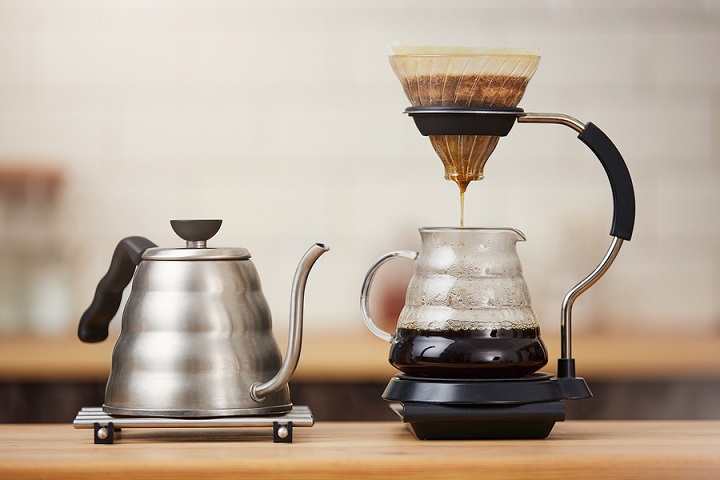
Pour-over coffee is less about owning a ritual and more about controlling a few useful variables: fresh coffee, a consistent grind, a sensible coffee-to-water ratio, clean water, and a repeatable pour. A simple plastic dripper, paper filters, a scale, and a decent grinder can make excellent coffee. A premium kettle and beautiful ceramic brewer can make the routine more pleasant, but they cannot rescue stale beans or wildly uneven grounds.
The brewing device you choose determines how forgiving the process feels. Open cone drippers reward small adjustments and give the brewer more control over flow. More restricted drippers make it easier to repeat a recipe with fewer pours. A large carafe brewer serves a group well but is needlessly cumbersome for one small cup. The right gear is the setup you will use before work, not the elaborate collection you think you should own.
We compared current brewers by capacity, filter format, flow control, materials, cleanup, and how much pouring technique they demand. We also focused on the supporting gear that actually affects the cup: scale, grinder, kettle, filters, and water. Prices, colors, and bundles change, so use the Amazon links to check today’s exact model.
Our picks at a glance
Best pour-over dripper for most people: Hario V60 Ceramic 02
Check the Hario V60 Ceramic 02 on Amazon
The Hario V60 Ceramic 02 is the classic choice for a reason: it is affordable enough to learn on, widely supported by filters and recipes, and responsive enough that the brewer can shape the cup without needing a complicated machine. Hario’s 02 ceramic version holds roughly one to four cups and uses a 60-degree cone with spiral interior ridges and an open bottom. The design lets you pour quickly for a lighter-bodied cup or more slowly for greater extraction and body.
That control is the V60’s strength and its learning curve. Grind size, pouring speed, how much you agitate the bed, and filter choice all change drawdown time and flavor. If a brew is sour or thin, the grind may be too coarse, the water may move through too quickly, or the ratio may be too weak. If it is bitter, dry, or slow, the grind may be too fine or the brew may be over-agitated. The V60 makes these cause-and-effect relationships easy to see once you change one variable at a time.
Choose the ceramic 02 if you make one to two larger cups, enjoy learning a repeatable method, and want a brewer you will not outgrow. Ceramic holds heat well but is breakable. If you are clumsy, travel frequently, or simply want a lighter cheaper entry point, a plastic V60 can be the more practical version of the same design. The quality of the coffee does not come from the material’s prestige; it comes from heat management, technique, and repeatability.
Best pour-over dripper for a simpler recipe: Hario V60 Mugen
Check the Hario V60 Mugen on Amazon
The Hario V60 Mugen is the best choice for a person who likes the clarity of paper-filter pour-over but does not want to make four separate pulse pours before the first coffee of the day. Its walls are flatter and have less ribbing than a classic V60, allowing the paper filter to cling more closely and creating more flow restriction. Hario specifically designs it for one slow, continuous pour and suggests starting with a slightly coarser grind than you would use for a standard V60.
That restricted flow gives the Mugen a more forgiving rhythm. You can bloom the coffee, then pour steadily to the target water weight without constantly managing a nearly dry brew bed. It will not make every coffee automatically delicious; freshness, grind quality, water temperature, and ratio still matter. But it removes some of the technique sensitivity that can make an open V60 frustrating for a beginner.
The 02 Mugen is best for one to two cups and uses 02-size V60 paper filters. Buy it if you value a calm daily routine over maximum manual control. Skip it if you enjoy experimenting with multiple pours, very fast filters, and different agitation patterns. In that case, the classic V60 gives you a wider adjustment range.
Best pour-over coffee maker for serving several people: Chemex Six Cup
Check the Chemex Six Cup on Amazon
The Chemex Six Cup is the right brewer for a larger shared pot and for drinkers who prefer a clean, light-bodied cup. Chemex measures its six-cup model at 30 ounces using its own five-ounce cup convention, so think of it as several smaller servings rather than six full mugs. The all-in-one glass carafe and cone make brewing and serving simple, while Chemex’s bonded paper filters are substantially heavier than common cone filters and contribute to the brewer’s clean, bright style.
That thick filter is a feature, not an inconvenience. It captures more fine particles and oils, creating a tea-like clarity that many people love with light and medium roasts. Others find it too clean or too light for their taste. Chemex also requires the right filter size and a little attention to folding and placement, especially around the spout where the paper should not block the air channel.
Choose the Six Cup when you commonly serve two to four people or want one carafe for a slow weekend breakfast. It is not the best solo weekday brewer: heating a large glass vessel and using big filters for one cup is wasteful and awkward. For individual servings, the V60 or Mugen makes more sense. Handle the glass carefully, avoid thermal shock, and never put a hot Chemex on a cold wet surface.
Best simple starter setup: Hario V60 Ceramic Pour-Over Set
Check the Hario V60 Ceramic Pour-Over Set on Amazon
The Hario V60 Ceramic Pour-Over Set is the easiest way to start without accidentally buying a dripper and discovering you still need filters and a server. Hario includes a ceramic 02 V60, a 600 ml heatproof glass server, and 100 natural-brown 02 filters. The server has a lid and handle, while the dripper uses the same familiar V60 format that has a deep recipe library and widely available supplies.
A set is not inherently better than assembling components individually. Buy it when you need most of the pieces, want a server with volume markings, and appreciate a coordinated starting point. Build your own kit when you already own a mug, carafe, scale, kettle, or filters. In either case, put some of the budget into a coffee scale and a good burr grinder before upgrading to decorative accessories.
The essential pour-over kit
Use a scale
A small digital scale is the biggest upgrade for repeatability. Scoops measure volume, but coffee bean density and grind size change how much coffee actually fits in a scoop. Water flow from a kettle also varies. A scale lets you use the same coffee dose and water amount every time, making it possible to learn from a result rather than guessing why today’s cup tasted different.
A practical starting ratio is 1 gram of coffee to 16 grams of water. For one substantial cup, try 20 grams of coffee and 320 grams of water. For a smaller cup, try 15 grams of coffee and 240 grams of water. This is a starting point, not a rule. If the coffee tastes too strong, use a little more water; if it tastes thin, use less water or adjust the grind after confirming the ratio.
Buy a burr grinder before an expensive dripper
Grind consistency matters more than owning the fanciest cone. Blade grinders chop beans into a mix of dust and boulders, which makes water extract some pieces too quickly and others too slowly. A burr grinder produces more uniform particles, making brew time and flavor easier to control. It is the upgrade that turns a frustrating pour-over setup into a repeatable one.
Our coffee grinder guide explains the difference between burr types, manual and electric grinders, and what to prioritize for a pour-over range. Grind immediately before brewing when possible, keep beans in a sealed container away from heat and light, and avoid buying huge bags of coffee that will go stale before you finish them.
Use a kettle you can control
A gooseneck kettle gives you a narrow, predictable stream, which is especially helpful with an open cone such as the V60. It lets you wet the coffee evenly and add water without blasting a crater through the grounds. You do not need a premium temperature-control electric kettle to make good coffee. A simple stovetop gooseneck plus a thermometer can work well, and a normal kettle can work if you pour slowly and carefully.
Temperature is useful, but consistency is more valuable than chasing a perfect number. Start around 195–205°F (90–96°C) for most coffee, use slightly cooler water for a darker roast if it tastes harsh, and use a little hotter water for a light roast that seems underdeveloped. Make one change at a time. Changing temperature, grind, ratio, and pouring pattern simultaneously makes it impossible to learn what helped.
Filters are part of the recipe
Paper filters affect flow, clarity, oils, and fine particles. Always buy the filter designed for the dripper size and shape. Hario’s V60 filters come in different sizes, and the 02 filter matches the 02 dripper. Chemex has different filter formats for its 3-cup and larger brewers. The filter that is “close enough” can collapse, overflow, or change the brew time dramatically.
Rinse paper filters with hot water before adding coffee. This warms the dripper and carafe, removes paper dust or flavor, and gives you a chance to check that the filter is seated correctly. Discard the rinse water, then add grounds and tare the scale before brewing.
A dependable starting recipe
For a Hario V60 02 or similar cone
Start with 20 grams of coffee and 320 grams of water, a 1:16 ratio. Grind medium-fine: finer than a typical flat-bottom drip machine grind but not powdery. Place and rinse the filter, add the grounds, level the bed with a gentle shake, and tare the scale.
Pour about 50 grams of water to wet all the grounds. Wait 30–45 seconds for the bloom, allowing trapped gas to escape. Then pour in slow controlled circles until you reach about 180 grams total. When the water level drops slightly, pour again to reach 320 grams. Aim to finish the main pours by around two minutes and let the coffee draw down. A total time around 2:30 to 3:30 is a useful starting window, not a scorecard.
Taste the result after it cools a little. If it is sour, sharp, salty, or thin, try a slightly finer grind or a slower more even pour. If it is bitter, astringent, dry, or painfully slow, try a slightly coarser grind or less agitation. Keep the ratio and water temperature steady while adjusting the grind. Write down what you changed; memory is not as reliable as a note on the coffee bag.
For a Mugen one-pour method
Start with the same 1:16 ratio but use a slightly coarser grind than your V60 recipe. Rinse the 02 filter, add and level the grounds, bloom briefly, then pour in one slow continuous stream to the target weight. Keep the stream centered enough to avoid spraying the sides of the filter. The Mugen’s more restricted walls are designed to extend contact time, so a finer grind that worked in a fast V60 may become too slow here.
For Chemex
Use a coarser grind than the V60 because the thick filter and larger brew bed create different flow. Start around 45 grams of coffee to 720 grams of water for a 1:16 ratio, adjusting down if you are brewing a smaller batch. Rinse the Chemex filter thoroughly, place the multiple-layer side toward the spout, and make sure it does not block the air channel. Bloom, then pour in several controlled pulses while keeping the slurry level stable.
Chemex brew times are typically longer than a small V60, especially with a larger batch. If the drawdown stalls, do not immediately assume you need more water. Check whether the grind is too fine, the filter is blocking the spout, or the coffee bed is clogged by too many fines. A clean, sweet cup is the goal, not a certain stopwatch number.
How to troubleshoot pour-over coffee
If the coffee tastes sour or weak
Sour, underdeveloped coffee often means insufficient extraction. Check whether the grind is too coarse, water temperature is too low, the brew ran very fast, or the ratio used too much water for the coffee dose. Adjust one element. The simplest first move is usually a slightly finer grind. Do not overcorrect by grinding dramatically finer; small changes reveal more.
If it tastes bitter, dry, or harsh
Bitter, astringent, or drying coffee can indicate over-extraction. Try a slightly coarser grind, gentler pours, less agitation, or somewhat cooler water for a dark roast. Check the filter and dripper for a stalled drawdown. Stale coffee can also taste flat, woody, or harsh no matter how carefully you pour.
If the brew is inconsistent
Use a scale, weigh the coffee and water, set a repeatable grind, rinse the same filter type, and make the same number of pours. Inconsistency usually comes from changing several variables unconsciously: a different scoop, different grind setting, no scale, changing kettle flow, or coffee that is aging. A simple notebook beside the brewer is more useful than a complicated app.
Common mistakes to avoid
- Buying a premium dripper before a grinder or scale. Consistent grounds and measured water improve coffee more reliably.
- Using the wrong filters. Match the brewer’s exact size and shape.
- Skipping the filter rinse. It can leave the brewer cold and add paper flavor.
- Changing every variable at once. Adjust grind, ratio, temperature, or pouring separately so you can learn.
- Pouring too aggressively. A controlled stream keeps the bed even and reduces unwanted agitation.
- Judging coffee while it is scalding hot. Let it cool slightly; sweetness and acidity become easier to evaluate.
- Using stale beans. Gear cannot restore coffee that has been sitting open or old for months.
How we chose
We compared current pour-over equipment by capacity, filter design, flow restriction, material, recipe flexibility, portability, and the number of servings each brewer handles comfortably. We selected an adjustable cone, a simpler one-pour brewer, a larger carafe format, and a starter set because these solve different problems. We also emphasized scale, grinder, kettle, and filters because they have more effect on repeatability than collecting extra brewers.
This is product research, not a claim that every coffee or water source will taste the same in every brewer. Coffee freshness, roast level, grind, filters, water, temperature, and technique all affect the result. Confirm current compatibility and product details before buying. SuperGrail links to Amazon for shopping and may earn a commission from qualifying purchases. That does not change how we explain the trade-offs.
Pour-over coffee FAQ
Do I need a gooseneck kettle?
No, but it makes pouring more controlled and repeatable, especially with a V60. A normal kettle can still make good coffee when you pour slowly. If you are choosing between a gooseneck kettle and a burr grinder, buy the grinder first.
What is the best coffee-to-water ratio?
Start with 1 gram of coffee to 16 grams of water. For example, use 20 grams of coffee and 320 grams of water. Then adjust for taste and the coffee you are using. A scale makes this much easier than relying on scoop measurements.
Why does my pour-over take too long?
The grind may be too fine, the filter may be partially blocked, the coffee may be producing many fines, or your pouring may be creating excessive agitation. Go slightly coarser first, confirm the filter is seated correctly, and pour more gently. Change one thing at a time.
Can I make one cup in a Chemex?
You can, but it is inefficient and more difficult to control than using a single-cup cone dripper. A Chemex is better for several servings. Choose a V60 or Mugen for daily one- or two-cup brewing.
How important is water quality?
Very. Water makes up nearly the entire cup. If your tap water tastes strongly chlorinated, metallic, or unpleasant, the coffee will reflect it. Use clean, good-tasting water and keep your kettle, server, and brewer free of old coffee residue.
Our approach: We explain the trade-offs behind every recommendation. If you buy through an Amazon link, SuperGrail may earn a commission—our research remains independent.